🚀 Social Media Marketing Strategy for Rapid Business Growth in India
By Mayur Kale | 28 Apr 2026
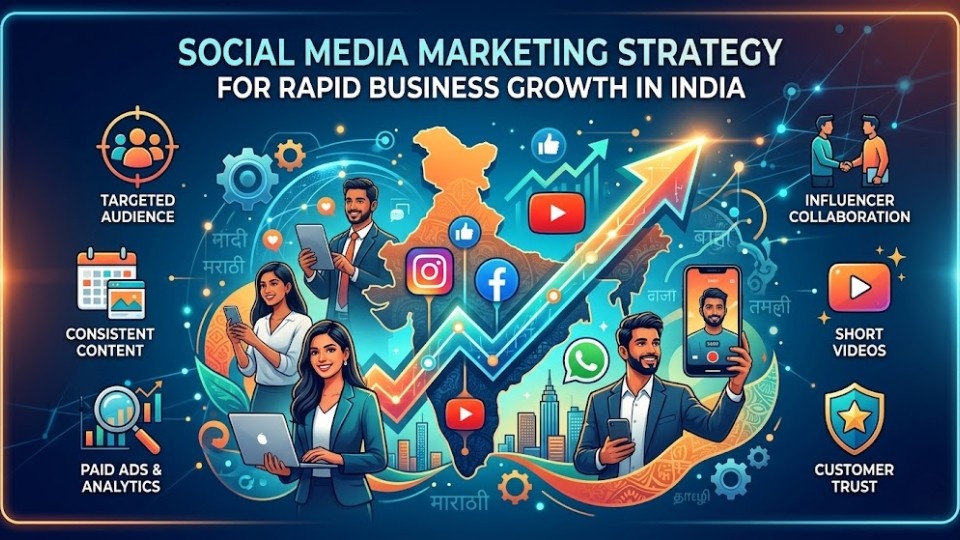
A Complete, Premium Guide to Building a Scalable Digital Brand
In today’s digital-first economy, social media is not just a marketing channel—it is the heartbeat of modern business growth. In India, where millions of users are coming online every month, platforms like Instagram, Facebook, YouTube, and LinkedIn have become powerful ecosystems where brands are built, scaled, and monetized.
Whether you are a startup, a local business, or an established brand, the right social media strategy can help you generate leads, increase visibility, and grow revenue faster than traditional marketing ever could.
But here’s the reality—
Most businesses fail on social media not because the platform doesn’t work, but because they lack a structured strategy.
This guide will walk you through a premium, step-by-step approach designed specifically for the Indian market.
🇮🇳 Understanding the Indian Digital Landscape
India is not just a market—it’s a diverse digital ecosystem.
A user in Mumbai behaves differently from a user in Nagpur or a Tier-3 city. Language, culture, income level, and content preferences all vary widely. This makes social media marketing in India both challenging and extremely rewarding.
For example, while urban audiences may engage with polished, aesthetic content on Instagram, users in smaller cities often respond better to relatable, emotional, and value-driven messaging—especially in regional languages.
This means your strategy cannot be “one-size-fits-all.”
It must be localized, personalized, and culturally relevant.
🎯 Building a Strong Foundation: Defining Your Goals
Before you even create your first post, you need clarity.
Ask yourself:
What does success look like for your business?
If your goal is brand awareness, your strategy will focus on reach and impressions.
If your goal is lead generation, your content and ads must push users toward action.
If your goal is sales, then everything—from visuals to captions—must drive conversions.
Without a clear objective, your efforts become scattered, and your results remain inconsistent.
A premium strategy always begins with purpose-driven execution.
👥 Deep Audience Understanding: The Real Growth Driver
One of the biggest mistakes businesses make is assuming they know their audience.
In reality, successful brands invest time in understanding:
- What their audience wants
- What problems they face
- What kind of content they consume daily
For instance, a fitness brand targeting young professionals will create very different content compared to a brand targeting middle-aged homemakers.
In India, language plays a crucial role. Content in Hindi, Marathi, or other regional languages often creates a strong emotional connection, leading to higher engagement and trust.
When your audience feels understood, they don’t just follow you—they buy from you.
📱 Platform Selection: Focus Beats Presence
Many businesses try to be everywhere—and end up growing nowhere.
Each platform serves a different purpose:
- Instagram thrives on visual storytelling and short-form content
- Facebook is powerful for community building and local targeting
- YouTube is ideal for long-form content and authority building
- LinkedIn dominates in B2B and professional branding
Instead of spreading yourself thin, focus on 2–3 platforms where your audience is most active and dominate them with consistency.
🎨 Content Creation: The Core of Your Strategy
Content is where your brand comes alive.
But premium content is not just about design—it’s about communication, psychology, and value.
Great content does one of three things:
- Educates
- Entertains
- Inspires
The most successful brands combine all three.
For example, a skincare brand might:
- Educate users about skin problems
- Share customer success stories
- Create engaging reels with trending formats
In India, emotional storytelling works exceptionally well. People connect with real stories, transformations, and relatable experiences.
Consistency is critical. Posting once a week will not build momentum. You need a structured content calendar that keeps your audience engaged regularly.
🎥 The Power of Video Marketing
If there’s one thing dominating Indian social media today, it’s video.
Short-form videos on Instagram Reels and YouTube Shorts have completely changed how content is consumed.
Why? Because video is:
- Easy to consume
- Highly engaging
- Algorithm-friendly
But success in video is not random. It requires a formula:
The first 3 seconds decide whether a user will continue watching or scroll away.
Your message must be clear and fast.
Subtitles are essential because many users watch without sound.
Most importantly, every video should have a clear purpose—whether it’s to educate, entertain, or convert.
💰 Paid Advertising: Scaling Your Growth
Organic reach can take you far—but ads take you further, faster.
Platforms like Facebook and Instagram offer highly targeted advertising options that allow you to reach the right audience based on demographics, interests, and behavior.
The key to successful advertising is testing.
Start with small budgets.
Experiment with different creatives.
Analyze what works.
One of the most powerful strategies is retargeting—showing ads to people who have already interacted with your brand. These users are more likely to convert, making your campaigns more cost-effective.
🤝 Influencer Marketing: Building Trust Faster
In India, trust plays a major role in buying decisions.
This is where influencers come in.
Instead of brands talking about themselves, influencers act as trusted voices who recommend products to their audience.
Interestingly, micro-influencers often outperform celebrities because their audience is more engaged and loyal.
Collaborations on Instagram and YouTube can help you:
- Reach new audiences
- Build credibility
- Drive sales
💬 Engagement: Turning Followers into Customers
Having followers is good—but engagement is what truly matters.
When people comment on your posts, reply to them.
When they message you, respond quickly.
Social media is not a one-way broadcast—it’s a conversation.
Brands that actively engage with their audience build stronger relationships, which eventually lead to higher conversions and customer loyalty.
📊 Analytics & Optimization: The Secret to Growth
No strategy is complete without measurement.
Social media platforms provide insights that help you understand:
- What content performs best
- When your audience is most active
- Which campaigns generate results
By analyzing this data, you can refine your strategy and continuously improve performance.
Growth is not about guessing—it’s about data-driven decisions.
⚡ Adapting to Trends & Staying Relevant
Social media trends change rapidly.
What works today may not work tomorrow.
Successful brands stay updated with:
- Trending audio
- Viral formats
- Platform updates
But here’s the key—don’t follow trends blindly.
Adapt them in a way that aligns with your brand identity.
🔥 Conclusion: Turning Strategy into Success
Social media marketing in India is full of opportunities—but only for those who approach it strategically.
It’s not about posting more—it’s about posting smarter.
It’s not about being everywhere—it’s about being effective where it matters.
When you combine:
- Clear goals
- Deep audience understanding
- High-quality content
- Smart advertising
- Consistent engagement
You create a system that doesn’t just grow your brand—it scales your business.
🚀 Final Thought
In the digital age, your social media presence is your digital storefront.
Make it powerful. Make it premium. Make it unforgettable.
Need help with digital growth?
This article is part of our broader work around websites, marketing, branding, content, software, and business growth support.
Related Posts
09 Oct 2026
Expert Digital Marketing Services in India: When Businesses Need Them
Expert Digital Marketing Services in India: When Businesses Need Them Businesses invest in...
Read More
06 Oct 2026
Leading Digital Marketing Services in India
Leading Digital Marketing Services in India: What Modern Businesses Need Digital marketing...
Read More
01 Oct 2026
Professional Digital Marketing Services in India
Professional Digital Marketing Services in India: What Businesses Should Expect Choosing p...
Read More