Why Every Local Business in India Needs Digital Marketing in 2026: The Ultimate Guide to Growth, Visibility, and Success
By Durgesh Sonar | 02 Jun 2026
Introduction: The Biggest Business Shift in Indian History
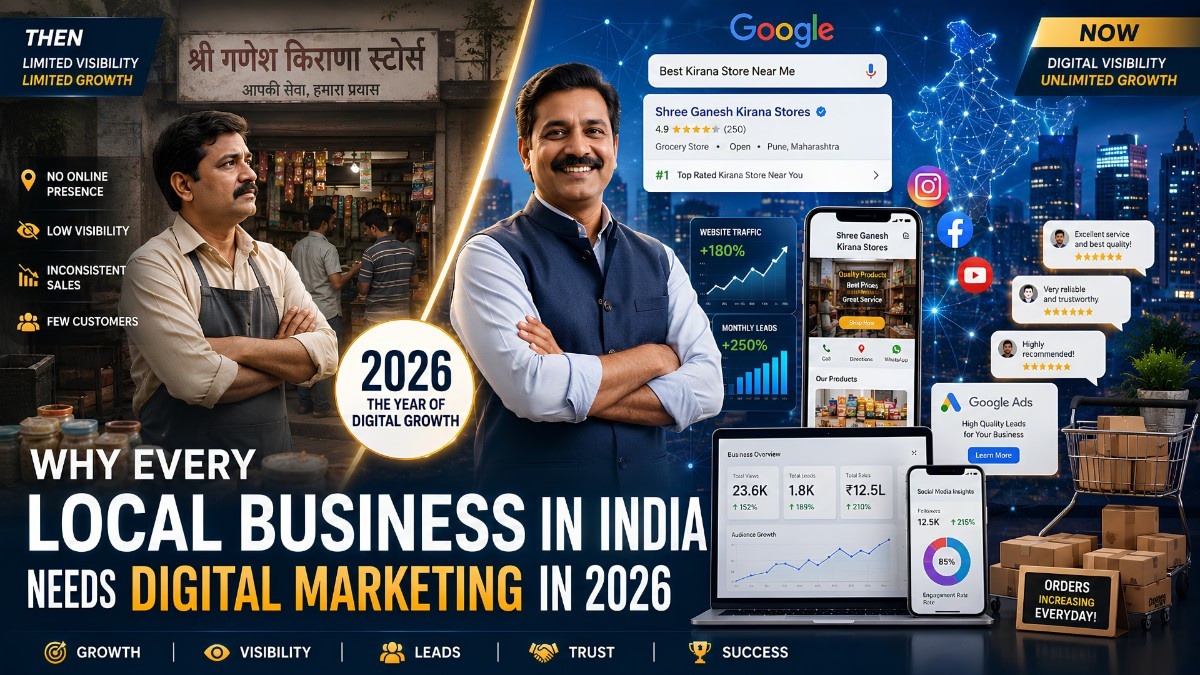
In a small town in Maharashtra, a shop owner opens his store every morning at exactly 9 AM. For more than fifteen years, his business has survived through hard work, loyal customers, and word-of-mouth referrals. He knows his products inside out. He treats customers like family. His prices are fair, and his reputation is strong.
Yet something has changed.
The number of customers walking into his shop is no longer what it used to be.
Sales have become unpredictable.
Some days are excellent, while others are surprisingly quiet.
Meanwhile, a newer competitor that opened only a few years ago seems to be growing rapidly. They are attracting younger customers, generating inquiries consistently, and expanding their business faster than expected.
The experienced shop owner cannot understand why.
After all, he has better products, more experience, and stronger local relationships.
The answer lies in a transformation that has quietly changed the way Indians discover, evaluate, and purchase products and services.
The competitor is visible online.
The older business is not.
This story is being repeated across thousands of cities, towns, and villages throughout India.
Whether it is a medical clinic in Jalgaon, a coaching institute in Pune, a restaurant in Nagpur, a construction company in Nashik, a textile manufacturer in Surat, or an export business in Delhi, the rules of business growth have fundamentally changed.
In 2026, customers do not simply walk into businesses.
They search for them.
They discover them online.
They compare them digitally.
They evaluate their reputation through reviews.
They judge their professionalism through websites and social media profiles.
And only then do they decide whom to contact.
This change has created an enormous opportunity for businesses that understand digital marketing and an equally significant challenge for those that ignore it.
Digital marketing is no longer an optional promotional activity.
It has become one of the most important business investments of the modern era.
Businesses that embrace it are growing faster than ever before.
Businesses that ignore it are becoming increasingly invisible.
Understanding why this shift has occurred and how businesses can benefit from it is essential for anyone who wants to succeed in the competitive marketplace of 2026.
The Evolution of Consumer Behavior in India
India has undergone one of the fastest digital transformations in the world.
A decade ago, most purchasing decisions were influenced primarily by personal recommendations, newspaper advertisements, local visibility, and direct interactions.
Today, smartphones have placed an entire marketplace in every consumer's pocket.
The modern Indian customer behaves very differently from previous generations.
Before visiting a store, customers search online.
Before contacting a service provider, they read reviews.
Before making a purchase, they compare multiple options.
Before trusting a business, they investigate its online presence.
This behavior spans every industry imaginable.
A patient searching for a doctor.
A parent looking for a school.
A family planning a vacation.
A company seeking a supplier.
A homeowner searching for an interior designer.
A student looking for coaching classes.
A business owner searching for a marketing agency.
Every one of these journeys begins online.
The businesses that appear during this process gain an opportunity to earn trust.
The businesses that do not appear often lose potential customers before they even know those customers existed.
The rise of digital behavior has permanently altered customer expectations.
Consumers expect information immediately.
They expect convenience.
They expect transparency.
They expect accessibility.
Businesses that fail to meet these expectations risk losing relevance in an increasingly connected world.
Why Visibility Has Become the Most Valuable Business Asset
Throughout history, successful businesses depended heavily on location.
A prime commercial location often guaranteed higher footfall and stronger sales.
Businesses invested heavily in securing locations with maximum visibility because visibility directly influenced revenue.
In the digital era, visibility still matters.
However, the location has changed.
Today, visibility exists online.
The modern equivalent of a prime location is a strong presence on Google, social media platforms, search engines, and digital directories.
Imagine a customer searching for a service you provide.
If your business appears on the first page of search results, you have an opportunity to earn their attention.
If your competitor appears instead, they gain that opportunity.
The difference can significantly impact revenue.
Digital visibility allows businesses to be discovered by people actively searching for solutions.
Unlike traditional advertising, which interrupts consumers, digital marketing places businesses directly in front of individuals already expressing interest.
This creates a level of marketing efficiency that was unimaginable only a few decades ago.
Visibility creates awareness.
Awareness creates trust.
Trust creates inquiries.
Inquiries create sales.
Sales create growth.
The entire process begins with visibility.
The Power of Search Engines in Modern Business
Google has become one of the most influential business platforms ever created.
Millions of searches occur every day across India.
People search for products, services, solutions, recommendations, reviews, and information.
The importance of these searches cannot be overstated.
When someone searches for a specific product or service, they are often demonstrating intent.
They are actively seeking a solution.
This makes search engine traffic incredibly valuable.
Unlike traditional advertisements that target broad audiences, search engines connect businesses with individuals who are already interested.
A business appearing prominently in search results gains access to highly qualified potential customers.
These are not random visitors.
These are individuals looking for exactly what the business offers.
This is why search engine optimization has become such an important component of digital marketing.
SEO helps businesses improve their visibility within search results, increasing the likelihood that potential customers will discover them.
For local businesses, the impact can be transformative.
Appearing prominently in local search results often leads to increased website traffic, more phone calls, greater footfall, and higher revenue.
Why Trust Is Built Online Before Customers Contact You
Trust has always been one of the most important factors influencing purchasing decisions.
What has changed is where trust is built.
Previously, trust developed primarily through personal interactions.
Today, much of that trust is established digitally.
Customers often form opinions about businesses before speaking with them.
A professional website communicates credibility.
Positive reviews create confidence.
Educational content demonstrates expertise.
Active social media profiles indicate engagement.
Consistent branding conveys professionalism.
These digital signals influence customer perceptions long before direct contact occurs.
Businesses with strong online reputations often enjoy significant advantages.
Customers feel more comfortable contacting them.
They perceive them as more reliable.
They are more likely to choose them over competitors.
This is particularly important because modern consumers have countless options.
When multiple businesses offer similar products or services, trust frequently becomes the deciding factor.
Digital marketing helps businesses build and reinforce that trust.
The Growing Importance of Social Media
Social media platforms have evolved far beyond their original purpose.
They are no longer merely channels for personal communication.
They have become powerful business tools.
Consumers spend substantial portions of their day on platforms such as Instagram, Facebook, YouTube, LinkedIn, and emerging social networks.
These platforms influence purchasing decisions in countless ways.
Businesses can showcase products.
Share success stories.
Educate audiences.
Answer questions.
Build communities.
Establish authority.
Strengthen customer relationships.
The businesses that understand how to use social media effectively are creating powerful competitive advantages.
They remain visible.
They stay relevant.
They engage directly with their audiences.
They build familiarity.
And familiarity often leads to trust.
Trust ultimately leads to sales.
Why Content Marketing Is Becoming Essential
One of the most significant developments in digital marketing is the rise of content.
Consumers increasingly seek information before making decisions.
They want answers.
They want guidance.
They want expertise.
Businesses that provide valuable content position themselves as trusted resources.
A well-written blog article can attract visitors from search engines.
A helpful video can educate potential customers.
A case study can demonstrate results.
An informative social media post can build credibility.
Content allows businesses to help potential customers before asking for anything in return.
This creates goodwill and trust.
Over time, businesses that consistently produce valuable content often become recognized authorities within their industries.
Authority creates competitive advantages that extend far beyond marketing.
It influences customer perceptions, purchasing decisions, and long-term business growth.
The Competitive Advantage of Digital Marketing
Digital marketing offers something that traditional marketing often struggles to provide.
Measurability.
Businesses can track website traffic.
Monitor inquiries.
Analyze customer behavior.
Measure advertising performance.
Identify successful strategies.
Optimize campaigns.
This data-driven approach enables continuous improvement.
Instead of relying on assumptions, businesses can make decisions based on evidence.
This increases efficiency.
Improves return on investment.
And supports sustainable growth.
The ability to measure results is one of the reasons digital marketing has become such an important business tool.
It transforms marketing from guesswork into strategy.
The Future of Business Belongs to Digital-First Companies
As technology continues evolving, digital marketing will become even more important.
Artificial intelligence is transforming search behavior.
Voice search is increasing.
Video content continues to dominate online engagement.
Consumer expectations are rising.
Businesses that adapt to these changes will be positioned for long-term success.
Those that fail to adapt may find themselves struggling to remain competitive.
The future belongs to organizations that understand how to combine excellent products and services with strong digital visibility.
Because regardless of industry, one reality remains constant.
Customers cannot buy from businesses they cannot find.
Conclusion
The business landscape of 2026 is fundamentally different from anything previous generations experienced.
Customers search online.
Research online.
Compare online.
Trust online.
And often make purchasing decisions online.
This shift has created enormous opportunities for businesses willing to embrace digital marketing.
Digital marketing helps businesses become visible, build trust, attract customers, generate leads, increase sales, and strengthen their brands.
It enables local businesses to compete effectively, regardless of size.
It creates opportunities for growth that extend far beyond traditional geographic limitations.
Most importantly, it ensures that when customers search for solutions, your business has the opportunity to be discovered.
The question facing local businesses is no longer whether digital marketing matters.
The evidence is overwhelming.
The real question is whether businesses are willing to adapt to the realities of the modern marketplace.
Those who embrace digital marketing will position themselves for growth, visibility, and success.
Those who ignore it risk becoming invisible in a world where visibility has become one of the most valuable assets a business can possess.
In 2026 and beyond, digital marketing is not simply a marketing strategy.
It is the foundation of sustainable business growth.
Need help with digital growth?
This article is part of our broader work around websites, marketing, branding, content, software, and business growth support.
Related Posts
16 Oct 2026
Mobile App Development Cost in India 2026
Mobile App Development Cost in India 2026: What Businesses Should Budget Planning a mobile...
Read More
12 Oct 2026
Result-Driven Digital Marketing Services in India
Result-Driven Digital Marketing Services in India: How to Measure Success Digital marketin...
Read More
09 Oct 2026
Expert Digital Marketing Services in India: When Businesses Need Them
Expert Digital Marketing Services in India: When Businesses Need Them Businesses invest in...
Read More