Result-Driven Digital Marketing Services in India
By DD Digital Solution | 12 Oct 2026
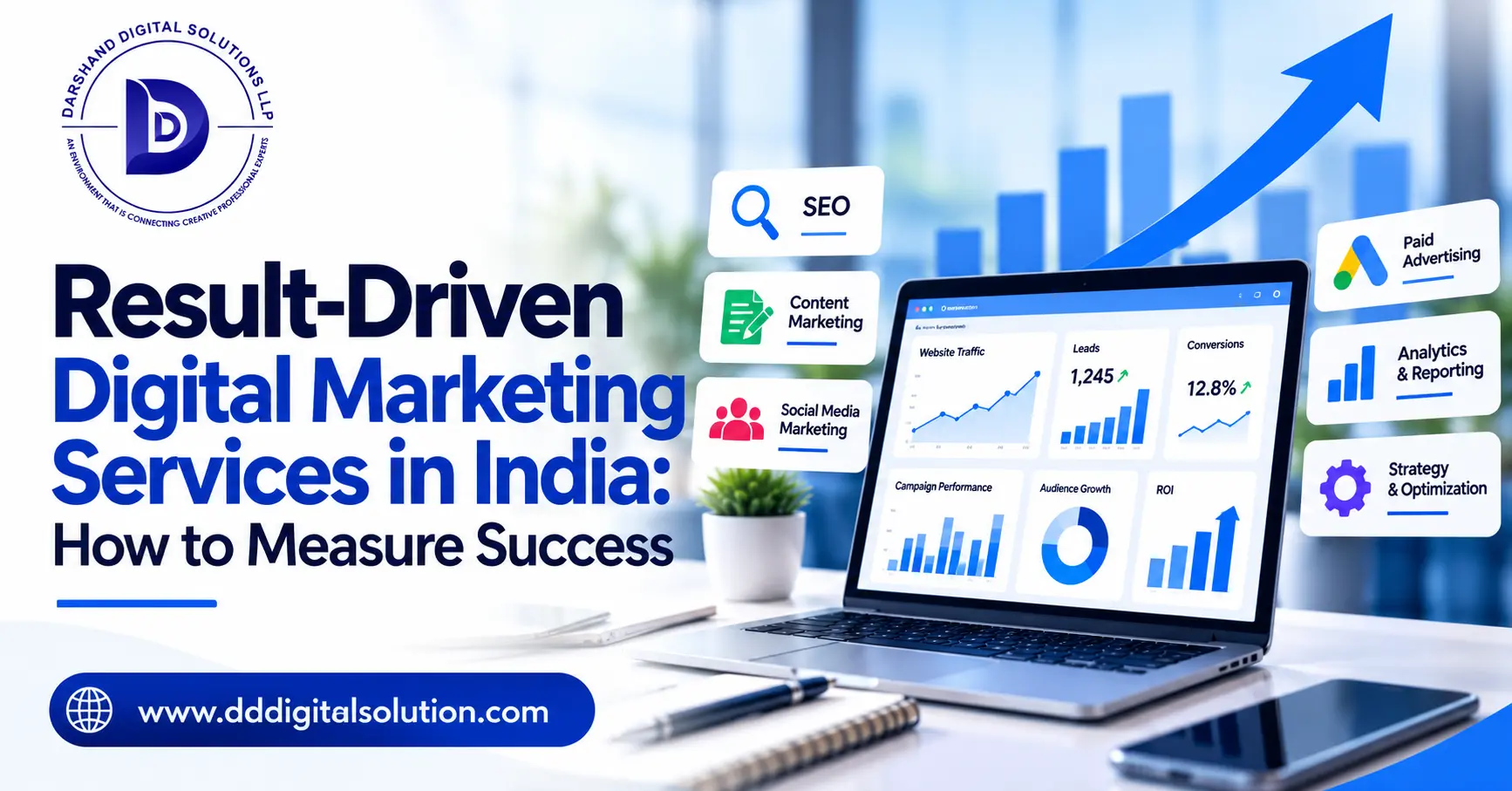
Result-Driven Digital Marketing Services in India: How to Measure Success
Digital marketing can generate website visits, social media engagement and advertising clicks, but these activities do not always translate into business growth. Businesses need to understand which marketing efforts attract relevant audiences, generate qualified enquiries and contribute to meaningful outcomes.
This is why result-driven digital marketing services in India should focus on measurable objectives rather than activity alone. A practical strategy connects marketing channels with business goals, establishes performance benchmarks and uses data to guide improvements. Whether a company invests in search engine optimization, content marketing, social media or paid advertising, measuring the right indicators helps decision-makers understand what is working and where resources should go next. The aim is not to promise instant results, but to build a more informed, consistent and accountable marketing process.
1. Define What Results Mean for Your Business
Before launching a campaign, businesses should decide what success looks like. Different objectives require different measurements.
For example:
-
An e-commerce business may prioritize purchases and revenue.
-
A B2B company may focus on qualified leads and sales opportunities.
-
A local service provider may measure calls, enquiries and appointment requests.
-
A new brand may initially focus on relevant reach and brand awareness.
A professional digital marketing strategy should connect these objectives with a defined audience, suitable channels and a realistic timeline.
Without clear goals, businesses risk treating every increase in traffic or engagement as success—even when it does not contribute to their actual priorities.
2. Track the Metrics That Matter
Not every marketing metric deserves equal attention. The most useful indicators depend on the campaign objective.
SEO performance
Monitor relevant organic traffic, search visibility, keyword performance, engaged visits and conversions from organic search. Rankings can provide context, but they should not be the only measure of SEO success.
Paid advertising
Review impressions, clicks, click-through rate, cost per click, conversion rate and cost per lead. Where reliable revenue data is available, businesses can also assess return on advertising spend.
Content and social media
Measure meaningful engagement, referral traffic, enquiries and the performance of content designed to support customer decisions.
A reliable digital marketing partner should explain these metrics in plain language and connect them to business outcomes. Reports should help answer questions, not simply present numbers.
3. Connect Marketing Data With Enquiries and Conversions
One of the biggest measurement challenges is understanding what happens after a user clicks an advertisement or visits a website.
A business might receive substantial traffic but few enquiries. The problem could involve an unclear service offering, a complicated contact form, irrelevant targeting or a landing page that does not match the visitor’s expectations.
To investigate, businesses can:
-
Set up conversion events for important actions.
-
Use analytics to understand traffic sources.
-
Track enquiry submissions and relevant calls where appropriate.
-
Review landing-page engagement and form completion.
-
Check whether leads are relevant to the business.
-
Connect marketing reports with sales outcomes when possible.
Tools such as Google Analytics and Google Search Console can help with different parts of this process. Correct configuration and consistent event definitions are essential for trustworthy reporting.
For businesses that need improvements across their website and marketing, DD Digital Solution’s Digital Marketing Services provide a relevant starting point for exploring its offering.
4. Understand ROI Without Misleading Yourself
Return on investment (ROI) helps businesses evaluate whether marketing expenditure creates sufficient value. However, calculating it requires reliable cost and outcome data.
A basic marketing ROI formula is:
\[ \text{ROI}=\frac{\text{Return}-\text{Investment}}{\text{Investment}}\times100 \]
For example, if a campaign generates ₹1,50,000 in attributable profit against a total investment of ₹50,000, the calculated ROI is 200%.
This example assumes the profit figure is accurate and attributable to the campaign. Revenue should not be substituted for profit without clearly stating the difference.
Businesses should also account for agency fees, advertising spend, creative production and other relevant costs. Attribution is not always straightforward, particularly when customers interact with multiple channels before converting.
A result-driven digital marketing company in India should communicate these limitations rather than present every lead or sale as a direct consequence of one campaign.
5. Improve Campaigns Through Continuous Optimization
Measurement is useful only when it informs decisions. Businesses should review performance regularly and make controlled changes based on evidence.
A practical optimization cycle includes:
-
Measure: Compare results against the original objective.
-
Diagnose: Identify where performance is falling short.
-
Test: Try a focused change in messaging, targeting or landing-page experience.
-
Evaluate: Compare the results over a suitable period.
-
Refine: Apply useful findings and continue monitoring.
For example, if an advertising campaign generates clicks but few qualified enquiries, the next step may be to review audience relevance and the landing page before increasing the budget.
The best approach is not necessarily to spend more. It is to understand the evidence, prioritize improvements and adapt to changing audience behaviour.
Businesses can also explore our related guides on Top Digital Marketing Services in India and Reliable Digital Marketing Services in India for further guidance on service selection and consistent execution.
Need help with digital growth?
This article is part of our broader work around websites, marketing, branding, content, software, and business growth support.
Related Posts
09 Oct 2026
Expert Digital Marketing Services in India: When Businesses Need Them
Expert Digital Marketing Services in India: When Businesses Need Them Businesses invest in...
Read More
06 Oct 2026
Leading Digital Marketing Services in India
Leading Digital Marketing Services in India: What Modern Businesses Need Digital marketing...
Read More
01 Oct 2026
Professional Digital Marketing Services in India
Professional Digital Marketing Services in India: What Businesses Should Expect Choosing p...
Read More